


The Person in Environment (PIE) Theory emphasizes the interconnectedness of individuals and their social, physical, and cultural environments. Widely applied in social work, this theory helps professionals understand the dynamic relationships between a person’s behavior and the contexts they live in. By analyzing environmental factors alongside personal traits, social workers can provide more holistic interventions that address both personal and systemic issues.
- What is Person in Environment Theory?
- How Can Persons and Environments Fit?
- The Dynamic Nature of Person-Environment Fit
- Relevance of Person-Environment Fit and Misfit
- Pros and Cons of PIE Theory
- Person in Environment Theory in Social Work Practic
- Historical Background and Theoretical Foundations of PIE Theory
- Practical Tools and Applications of PIE Theory
- Benefits and Pitfalls of PIE Assessment Tools
- Person-Environment Interplay and Intervention Strategies
- Conclusion
- FAQs
- Q1: What are some good PDF articles on Person in Environment Theory?
- Q2: Where can I find a Person-in-Environment Theory PDF?
- Q3: Are there any Person in Environment Theory articles from 2022?
- Q4: Where can I find Person in Environment Theory articles from 2020?
- Q5: Is there a Person-in-Environment Theory PDF specifically for social work?
- Q6: Can you give an example of Person-in-Environment Theory in social work?
- Q7: What is an example of the Person-in-Environment perspective?
- Q8: How can I find Person-in-Environment Theory resources on Google Scholar?
Discover how the Person in Environment Theory transforms social work by connecting individuals with their surroundings for better well-being.
What is Person in Environment Theory?
The Person in Environment Theory, sometimes called Person-in-Environment Perspective, is a framework used primarily in social work to assess individuals within the context of their environments. Developed to move beyond viewing problems solely within the individual, it focuses on the interactions between a person and their social, economic, cultural, and physical surroundings.
This approach is particularly valuable because it recognizes that challenges like poverty, discrimination, or family dysfunction are not just personal issues, they are influenced by environmental factors that must be addressed for sustainable solutions.
Key Components of PIE Theory:
- Person: The individual, including biological, psychological, and emotional factors.
- Environment: Social systems, community, family, economic status, and cultural norms.
- Interaction: The reciprocal relationship between person and environment.
- Functioning: Assessment of how well a person adapts to their environment and the challenges they face.
How Can Persons and Environments Fit?
The PIE framework highlights the fit or misfit between an individual and their environment. A good fit occurs when personal needs align with environmental resources, promoting well-being and adaptive functioning. Conversely, a misfit can exacerbate stress, maladaptive behavior, and social challenges.
Table: Person-Environment Fit Examples
| Scenario | Person Factors | Environment Factors | Outcome |
|---|---|---|---|
| Student thriving academically | Motivation, resilience | Supportive school, accessible resources | Success, positive development |
| Unemployed adult struggling | Skills gap, low confidence | Limited job opportunities, economic hardship | Stress, low self-esteem |
| Elderly living alone | Health decline | Limited social support, inaccessible facilities | Isolation, health deterioration |
This table demonstrates how the environment can either support or hinder a person’s functioning, emphasizing the theory’s holistic nature.
The Dynamic Nature of Person-Environment Fit
The relationship between individuals and their environments is not static. Life changes, such as moving, career transitions, or health challenges, can alter the fit. Social workers using PIE theory continuously assess these dynamics to implement timely interventions.
For example, a young adult may function well in college but struggle when transitioning to the workforce. Environmental adjustments (mentorship programs, accessible resources) alongside personal development efforts can restore balance and foster positive outcomes.
Relevance of Person-Environment Fit and Misfit
Understanding fit and misfit has practical applications in social work:
- Assessment: Evaluates both personal and environmental factors, providing a complete picture of challenges.
- Intervention: Helps design interventions targeting environmental changes (community support, policies) as well as personal development.
- Advocacy: Supports efforts to influence social policies and resources to improve individual outcomes.

Pros and Cons of PIE Theory
Pros
- Holistic Perspective: Addresses both individual and environmental factors.
- Practical for Social Work: Provides a structured framework for assessment and intervention.
- Empowers Advocacy: Encourages systemic solutions alongside personal support.
- Dynamic and Flexible: Adapts to changing life circumstances.
Cons
- Complex Implementation: Requires extensive data collection on both personal and environmental aspects.
- Time-Consuming: Holistic assessment and interventions can take significant time.
- Environmental Constraints: Social workers may face limitations in altering systemic issues.
- Subjectivity: Assessing environmental fit can sometimes be influenced by personal biases.
Person in Environment Theory in Social Work Practic
In social work, PIE theory is often applied in diverse settings:
- Clinical Social Work: Understanding mental health issues within family and community contexts.
- Community Social Work: Assessing and addressing systemic issues like poverty, housing, and access to healthcare.
- School Social Work: Supporting students by considering family, peer, and school environment factors.
- Policy Advocacy: Informing policymakers about systemic barriers affecting populations.
Example:
A social worker assisting a homeless individual evaluates personal strengths (skills, motivation) and environmental barriers (housing availability, social support, employment opportunities). Intervention might involve skill-building programs, connecting with local shelters, and advocating for housing policy improvements.
Historical Background and Theoretical Foundations of PIE Theory
The Person in Environment (PIE) Theory was developed to address a gap in traditional social work approaches, which often focused solely on individual deficits. Rooted in the ecological perspective, PIE emphasizes the dynamic interplay between a person and their environment. Early pioneers, such as Charles D. Garvin and his contemporaries, highlighted that individuals cannot be understood in isolation; their behaviors, challenges, and growth are inherently connected to family, community, culture, and societal systems.
The theoretical foundation of PIE combines elements of psychology, sociology, and social work practice, creating a multidimensional framework. Unlike other models that may focus only on personal pathology or therapy, PIE incorporates environmental factors such as economic conditions, cultural norms, and social networks. This holistic approach enables social workers to design interventions that not only support personal development but also address systemic barriers, ensuring sustainable outcomes for clients.
Practical Tools and Applications of PIE Theory
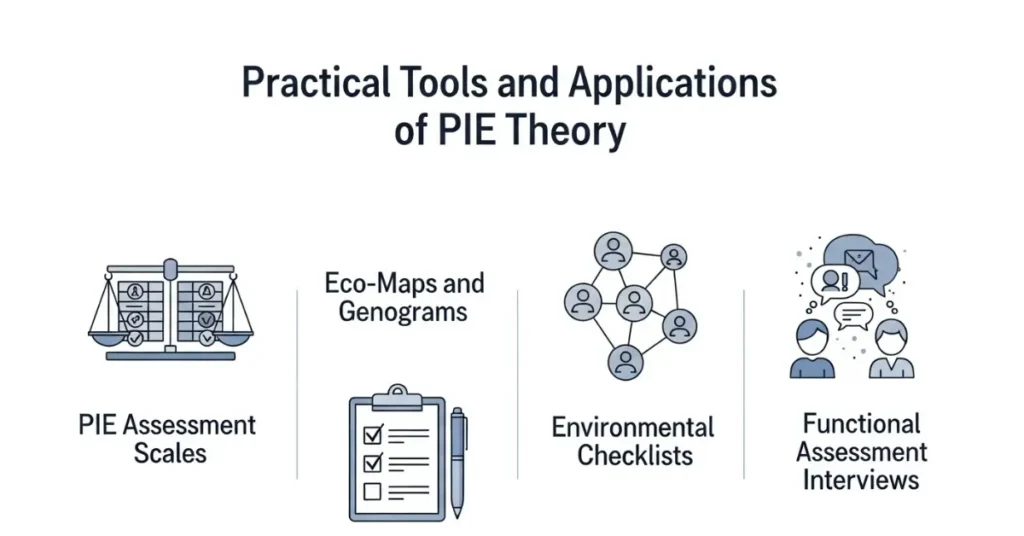
In practice, the Person in Environment Theory is applied through structured tools and assessments that evaluate both individual and environmental factors. Some commonly used tools include:
- PIE Assessment Scales: These scales quantify the interaction between personal functioning and environmental support, helping social workers identify areas of fit and misfit.
- Eco-Maps and Genograms: Visual tools that map family, social, and community relationships to understand the support systems and potential stressors in a client’s life.
- Environmental Checklists: Assess resources, barriers, and environmental factors affecting client well-being, from housing and employment to neighborhood safety.
- Functional Assessment Interviews: One-on-one discussions that explore the client’s coping strategies, personal strengths, and challenges within their environment.
These tools are highly versatile, enabling applications across diverse settings such as mental health clinics, schools, community programs, and policy advocacy initiatives. For instance, a school social worker might use an eco-map to identify a student’s social supports and challenges, guiding targeted interventions to improve academic and emotional outcomes. Similarly, community-based social work projects often leverage PIE assessments to address systemic issues like poverty or housing insecurity, demonstrating the theory’s adaptability and practical value.
Benefits and Pitfalls of PIE Assessment Tools
Assessment tools based on PIE theory provide structured evaluation but must be applied thoughtfully.
| Tool | Benefits | Pitfalls |
|---|---|---|
| PIE Assessment Scales | Standardized evaluation, easy comparison | May overlook nuanced personal experiences |
| Environmental Checklists | Focus on systemic factors, highlights resource gaps | Can be time-consuming, requires up-to-date data |
| Functional Assessment Interviews | Provides personalized insights | Subjective interpretation, may require multiple sessions |
Person-Environment Interplay and Intervention Strategies
Successful social work intervention relies on modifying environmental stressors while enhancing personal coping skills. Strategies include:
- Resource Connection: Linking clients to community resources like shelters, education, or counseling.
- Skill Development: Building personal strengths such as coping mechanisms or vocational skills.
- Policy Advocacy: Working to remove systemic barriers affecting vulnerable populations.
- Ongoing Evaluation: Continuously assessing environmental and personal changes to maintain a good fit.
Conclusion
The Person in Environment Theory offers a comprehensive, holistic approach to social work. By recognizing the intricate interplay between individuals and their environments, social workers can design interventions that are not only effective but also sustainable. This perspective ensures that solutions address both personal and systemic factors, creating lasting positive outcomes.
FAQs
Q1: What are some good PDF articles on Person in Environment Theory?
A: You can access PDF articles on PIE theory via academic journals, research databases, and Google Scholar for comprehensive studies.
Q2: Where can I find a Person-in-Environment Theory PDF?
A: Many universities and social work research platforms offer downloadable PIE theory PDFs for study and reference.
Q3: Are there any Person in Environment Theory articles from 2022?
A: Yes, 2022 articles focus on updated applications of PIE in social work and recent case studies.
Q4: Where can I find Person in Environment Theory articles from 2020?
A: 2020 publications cover foundational concepts, practical examples, and PIE interventions in social work practice.
Q5: Is there a Person-in-Environment Theory PDF specifically for social work?
A: Yes, these PDFs detail how PIE theory is applied in clinical, school, and community social work settings.
Q6: Can you give an example of Person-in-Environment Theory in social work?
A: Example: A social worker assists a homeless client by evaluating personal strengths and environmental barriers to housing and employment.
Q7: What is an example of the Person-in-Environment perspective?
A: Example: Assessing a student’s performance by considering family support, school environment, and peer interactions.
Q8: How can I find Person-in-Environment Theory resources on Google Scholar?
A: Search for “Person-in-Environment Theory” on Google Scholar to access research papers, case studies, and academic articles.