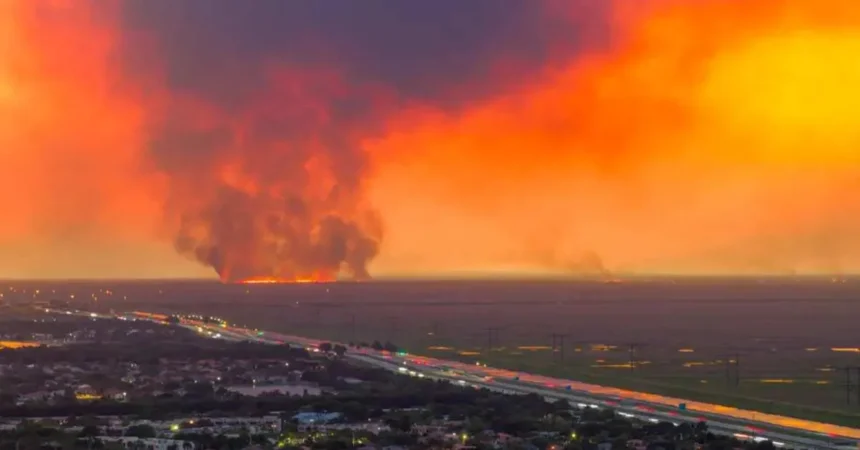
The Everglades wildfire burned nearly 50,000 acres, filling South Florida’s air with harmful smoke.
Scientists used advanced tools to study pollution levels and health impacts in real time.
Doctors warned vulnerable groups to stay indoors as smoke worsened breathing problems.
Experts linked the crisis to climate change and compared it to Los Angeles air quality poor events.
Officials now push for better wildfire prevention and stricter air quality measures.
Everglades Fire & Air Quality Crisis
The Everglades wildfire triggered a major air quality emergency in South Florida as nearly 50,000 acres burned in late August. Thick smoke covered large areas for days raising concerns about public health and environmental safety. Experts noted similarities with Los Angeles air quality poor warnings in recent years emphasizing how urban and rural regions both face air pollution risks after major wildfires.
Research and Data Insights
Advanced Monitoring Efforts
Scientists at the University of Miami launched intensive studies using cutting edge tools like the SPAMS mass spectrometer. These instruments detected elevated levels of potassium, nitrates and sulfates during the fire providing critical data for health alerts and future risk assessments.
Technology Collaboration
NASA satellites and AI models tracked smoke in real time, revealing how winds spread pollution. Similar tools help during Los Angeles air quality poor events, guiding emergency responses.
Health Impacts and Safety Measures
Doctors confirmed that wildfire smoke affects vulnerable groups the most children, seniors, and asthma patients. Tiny particles under 2.5 microns can enter deep into the lungs and bloodstream, increasing the risk of long-term respiratory illnesses.
Health officials advised staying indoors, using air purifiers, and limiting outdoor activities. Similar precautions have been recommended during Los Angeles air quality poor alerts, highlighting the shared public health challenges across regions.
Weather and Climate Factors
Meteorologists revealed that Hurricane Erin’s winds carried smoke across populated areas, while a lack of rain allowed pollutants to linger longer in the air. This combination prolonged the crisis, similar to conditions that worsen Los Angeles air quality poor during California wildfires.
Experts stress that future studies must explore how climate change droughts, and extreme weather events amplify wildfire risks and health hazards.
Comparative Analysis with Other Fires
Researchers compared the Everglades smoke to Canadian and West Coast wildfires, discovering different chemical compositions in each event. While Canadian fires sent smoke across multiple states, West Coast fires produced higher carbon-based particles.
This variability makes predicting air quality impacts difficult as seen during Los Angeles air quality poor conditions when pollution levels spike unpredictably.
Economic and Social Impact
The Everglades wildfire not only harmed the environment but also disrupted local businesses, tourism, and daily life. Flight delays, outdoor event cancellations, and rising healthcare visits added unexpected economic costs to the crisis.
Community groups compared the disruption to Los Angeles air quality poor alerts where schools close and outdoor activities halt due to smoke hazards, showing how wildfires impact both health and livelihoods.
Policy, Prevention, and Climate Link
Authorities are considering stricter air quality rules and smarter wildfire prevention measures. Controlled burns remain a key strategy for reducing future fire risks but require careful planning to avoid worsening air quality.
Scientists also warn that climate change is intensifying wildfire frequency and severity. Large fires release massive carbon emissions adding to global warming a problem mirrored by Los Angeles air quality poor episodes following urban wildfires.
Future Preparedness and Public Awareness
Experts call for stronger wildfire preparedness plans and public awareness campaigns to prevent future risks. Authorities are testing real-time air quality alerts to avoid Los Angeles air quality poor-type situations where schools close and activities stop. Scientists also urge more research funding as climate change drives stronger wildfires threatening lives, businesses and the environment.