
Software licensing used to be simple. You bought software, accepted a license, and moved on. Today, that world no longer exists. Modern applications are stitched together from open source libraries, cloud services, AI generated code, and third party APIs. Every line of code carries legal and financial implications.
- Overview
- The Current State of Software Licensing: Why a Revolution Is Needed
- Trend 1: AI Generated Code and the Need for Automated Attribution
- Trend 2: Decentralized and Autonomous Software Registries
- Trend 3: SBOM Becomes Mandatory and Machine Readable
- Trend 4: The Evolution of Software Licenses
- Why License Auditing Matters More Than Ever
- What Is Doge Software and Why It Matters
- Performing a Doge License Audit: Step by Step
- HUD (Heads Up Display): The Future of Unified Developer Compliance
- Best Tools and Practices for License Auditing
- Real World Use Cases and Examples
- Conclusion: Turning License Burden into Strategic Advantage
- FAQs
That is why conversations around doge software licenses audit hud are becoming more common among developers, legal teams, enterprises, and even regulators. License compliance is no longer a paperwork task. It is a continuous operational reality.
If you do not know exactly what code is running in your software, you do not actually know your legal risk.
Overview
Today, we explores how software licensing is evolving, why audits matter more than ever, and how Doge is positioning itself as a modern solution through software license audits and HUD driven compliance visibility. We will walk through key trends, practical audit steps, tools, pitfalls, and real world examples in a friendly and easy to follow way.
The Current State of Software Licensing: Why a Revolution Is Needed
Modern software development has outgrown the old ways licenses were designed to work. Traditional licenses assumed clear ownership, static distribution models, and predictable usage. None of that applies today.
How modern software development has outgrown traditional licensing models
Developers now pull dependencies from public repositories in seconds. Cloud native systems scale automatically. AI tools generate code that did not exist a moment ago. In this environment, manual license tracking becomes unrealistic.
Key pressures: AI code, open source explosion, and regulatory demands
Open source adoption has exploded. While it accelerates innovation, it also multiplies license obligations. At the same time, regulators now expect transparency about what is inside software, especially for infrastructure and government related systems.
Failure to adapt licensing practices creates blind spots that can later turn into lawsuits, forced rewrites, or blocked deployments.
Trend 1: AI Generated Code and the Need for Automated Attribution
AI tools are now active contributors to production codebases. This changes licensing in fundamental ways.
Why AI created code complicates licensing
AI models are trained on vast amounts of public and private code. Questions around attribution, derivative works, and license inheritance remain unresolved in many regions. Developers may not even know which sources influenced the output.
The future of automated license tracking
The only scalable answer is automation. License tracking tools will increasingly integrate directly into IDEs, CI pipelines, and AI assistants. Every generated snippet will need real time attribution checks and risk flags.
This shift is a key reason why doge software licenses audit hud is gaining attention as a proactive system rather than a reactive audit checklist.
Trend 2: Decentralized and Autonomous Software Registries
Centralized registries worked when ecosystems were smaller. Today, decentralization offers new possibilities.
How decentralized registries change ownership, traceability, and compliance
Decentralized software registries can record code ownership, license terms, and modification history in tamper resistant ways. This improves traceability and audit confidence while reducing disputes.
Autonomous registries also support machine readable licenses, which aligns perfectly with automated audits and HUD based license dashboards.
Trend 3: SBOM Becomes Mandatory and Machine Readable
Software Bill of Materials, or SBOM, is no longer optional in many industries.
Why SBOMs are becoming a legal requirement
Governments and large enterprises want visibility into software supply chains. SBOMs list every component, its version, and its license. This helps identify vulnerabilities and compliance gaps quickly.
Their role in transparency and risk reduction
Machine readable SBOMs allow systems to continuously assess risk. When a license changes upstream, alerts can trigger automatically. This reduces both security exposure and legal surprises.
Trend 4: The Evolution of Software Licenses
Licenses themselves are evolving to keep up with reality.
Cloud native copyleft
Traditional copyleft licenses were built for on premises distribution. Cloud native copyleft focuses on network use and service provision, closing loopholes around SaaS platforms.
Ethical source licensing
Some licenses now include ethical clauses about how software can be used. This raises new compliance challenges, especially for global organizations.
What these shifts mean for developers and enterprises
Developers must think beyond compatibility and performance. Legal intent and ethical constraints now matter at design time, not just at release.
Why License Auditing Matters More Than Ever
Audits are no longer about catching mistakes at the end. They are about reducing continuous risk.
Legal, financial, and reputational risks
License violations can trigger lawsuits, forced disclosure of proprietary code, fines, or public reputational damage. In regulated sectors, they can even block market access.
Compliance in multi source and AI powered codebases
When code comes from thousands of sources including humans and machines, audits must be continuous and contextual. Static spreadsheets simply cannot keep up.
This is where doge software licenses audit hud enters the conversation.
“Modern compliance is not about control, it is about visibility.”
What Is Doge Software and Why It Matters
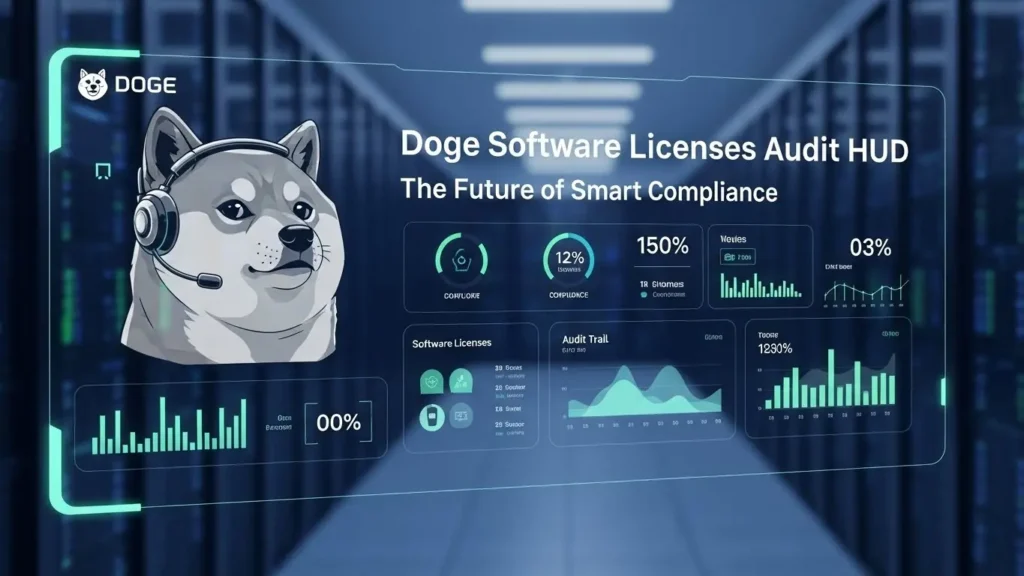
Doge Software approaches license management as a real time system rather than a quarterly task.
Introduction to Doge’s approach to modern license management
Doge focuses on automated discovery, machine readable attribution, and continuous monitoring. Instead of waiting for audits, compliance becomes an always on process.
How it fits into future compliance trends
By aligning with SBOM standards, AI code tracking, and decentralized registries, Doge positions itself to adapt as regulations and development practices evolve.
Performing a Doge License Audit: Step by Step
A Doge license audit is designed to be practical, not disruptive.
A practical walkthrough for developers and organizations
First, Doge scans the codebase and dependencies. Next, it maps licenses to known obligations. Then, the HUD displays risks, conflicts, and required actions in real time.
Finally, teams resolve issues early instead of scrambling before release.
Typical audit stages overview
| Stage | What Happens | Outcome |
| Discovery | Code and dependencies analyzed | Full inventory |
| Attribution | Licenses identified and classified | Clear obligations |
| Risk Scoring | Conflicts and violations flagged | Prioritized actions |
| Continuous Monitoring | Changes tracked over time | Ongoing compliance |
You might be interested in: Top AI Avatar Tools for Virtual Event Hosting: A Complete 2025 Guide
HUD (Heads Up Display): The Future of Unified Developer Compliance
A HUD transforms compliance from paperwork into insight.
Centralizing license visibility
Instead of scattered reports, teams see everything in one place. Dependencies, licenses, risks, and suggested fixes are visible at a glance.
Real time alerts, automated suggestions, and risk scoring
When a risky license enters the codebase, the HUD alerts the team immediately. Suggestions help developers choose safer alternatives without slowing down.
This real time feedback loop is one of the strongest aspects of doge software licenses audit hud.
Best Tools and Practices for License Auditing
No single tool fixes compliance alone.
Modern auditing platforms
Modern platforms integrate scanning, SBOM generation, and policy enforcement into CI CD pipelines. They support multiple languages and ecosystems.
Automation, scanning, and continuous compliance workflows
Best practice includes automated scans on every commit, policy based blocking of risky licenses, and regular reviews with legal teams.
Avoiding Legal Pitfalls and Ensuring Full Compliance
Most compliance failures are preventable.
Common mistakes
Teams often rely on outdated license lists or assume open source means free of obligation. Another mistake is limiting audits to release time only.
How to prevent violations and security risks
Start early, automate aggressively, educate developers, and keep legal teams involved throughout the lifecycle.
Real World Use Cases and Examples
Organizations that adopt modern audits see real benefits.
How organizations transformed compliance into an advantage
Some companies now use their strong compliance posture as a selling point, especially in enterprise and government contracts. Faster audits also speed up procurement and partnerships.
Instead of slowing innovation, compliance builds trust.
Conclusion: Turning License Burden into Strategic Advantage
Software licensing is no longer a background concern. It sits at the intersection of law, security, and innovation. Teams that treat compliance as an afterthought will struggle.
By embracing tools like Doge software licenses audit HUD and building continuous visibility into code, organizations can future proof development, reduce risk, and move faster with confidence.
FAQs
What is the relationship between Doge and Adobe?
Doge focuses on software license auditing and compliance visibility, while Adobe provides creative and document tools like Acrobat. They address different needs but may coexist in enterprise environments.
Does Doge work with Deloitte contracts?
Many consulting led environments require strict license transparency. Doge style audits can help organizations meet audit and reporting expectations set by large consultancies.
Is Accenture DOGE related?
Accenture is a global services firm. Doge refers here to a software platform approach for license auditing, not a consulting brand.
How does Doge compare with KPMG related audits?
Traditional audit firms focus on periodic reviews. Doge emphasizes continuous, automated license compliance rather than point in time audits.
What is Adobe Acrobat?
Adobe Acrobat is a document management and PDF solution widely used for viewing, editing, and signing PDF files.
Is Doge suitable for small teams?
Yes. Automated license HUD systems scale down well, helping small teams avoid issues early instead of fixing them later.
Can Doge handle open source and AI generated code together?
Modern Doge style audits are designed to track both open source dependencies and AI assisted code contributions in the same workflow.